Monday, October 22, 2012

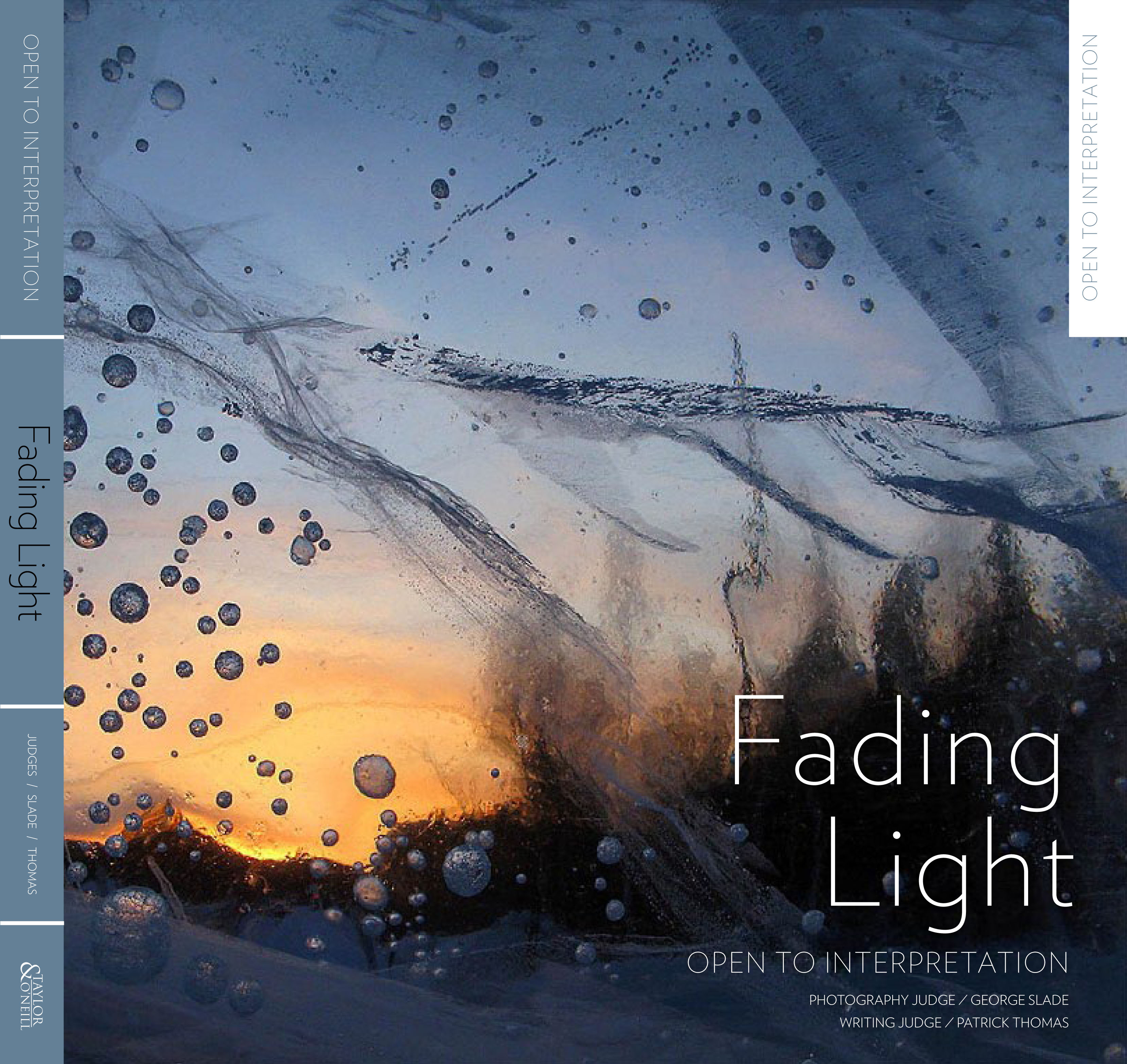
Contest: Open to Interpretation seeks prose and poetry on "Fading Light," seeks photos on "Love + Lust"


Open to Interpretation (US) is a juried book competition of photography, poetry, and prose. Theme: Fading Light. Submission fee: $20 for 3 poems or prose; $10 each additional.

View the photo gallery of images selected for Fading Light here, choose an image that inspires you, craft your interpretation of the image in poetry or prose and submit.  

Prize: $500, and authors of entries selected for inclusion in Fading Light will receive a free copy.  Deadline: November 13, 2012.

For photographers, Open to Interpretation is currently seeking photos on the theme Love + Lust.Lust is an intense appetite, craving, or untamed desire. We lust for an array of things—money, power, objects, sex, or just living life. Love is a powerful affection or personal attachment and comes in a variety of forms, which can encompass romantic, sexual, platonic, narcissistic, or even religious feelings or attitudes. And sometimes love and lust overlap. Show us your interpretations. Who or what do you love or lust for? What images capture these emotions for you?

Submission Fee: $40 for 5 images, ($10 each additional)
In February, once the photos are selected, they’ll be seeking prose and poetry pieces to accompany the pictures.

Prizes
Cover Image: $1,000 
Judge's Choice Award for Photography: $500
Judge's Choice Award for Writing: $500

See Brian Henry's schedule here, including writing workshops and creative writing courses in Kingston, Peterborough, Toronto, Mississauga, Brampton, Georgetown, Milton, Oakville, Burlington, St. Catharines, Hamilton, Dundas, Kitchener, Guelph, London, Woodstock, Orangeville, Newmarket, Barrie, Gravenhurst, Sudbury, Muskoka, Peel, Halton, the GTA, Ontario and beyond.

Sunday, October 21, 2012

"Visiting Vimy" an award-winning essay by Brenda Ross


The phone rang, a wake-up call to my hotel room that morning, and I almost changed my mind.  I could barely move to answer the phone, let alone get out of bed.  Jet lag left me in an earlier time zone, my entire being exhausted.  Perhaps I would sleep late and stay. After all, Paris is for tourists.

Then it called to me.  Closer than ever before, “You’re almost here,” it called… and I found the energy to get up.

A few hours and a train ride later, the sun was shining and the sky clear blue as the taxi turned off a two lane road onto a secluded laneway.  Had I been driving, I am sure I would have missed it altogether.  Up the gentle incline of the tree-lined laneway the taxi drove, popping in and out of dappled sunlight. It came to a sudden halt in front of a locked gate.  Could it be closed? My gracious driver brought relief when he pointed to his watch then a posted sign indicating in French the park did not open until ten o’clock and it was only a little after nine. 

With trepidation, I handed him payment and stepped from the cab. What was I doing here, by myself, in the middle of nowhere?  A return train ticket to Paris in my pocket held no reassurance.  I had no clue how to get back to the train station.  All I knew was that I had reached Vimy Ridge.  All other challenges paled in comparison.

My friendly driver drove off, the sound of his tires fading to silence.  It was a beautiful spring Saturday morning, the grass around me lush and green.  Trees, proudly displaying their bright new foliage, gently waved greetings in the slight breeze.  The signs around me looked strangely familiar: brown with bilingual yellow print, English and French, yet I could not quite place where I had seen them before.

Not knowing my bearings, I wandered along a gravel path a short distance to see huge, gaping holes in the ground.  The diameter of each hole ranged from twelve to fifteen meters across. The inner slopes, blanketed in the same velvety grass, steeply dropped to a similar depth. These holes resembled craters. Narrow trenches carved deep into the earth, upheld with cemented sandbags, snaked between the craters.  The trenches were marked, helping me to clearly understand where I stood and what I was looking at: ‘The German Front’.

Turning from this place, I started back toward the gate that had abruptly stopped my earlier progress.  The peaceful pathway was newly paved asphalt, mostly under the protection of maples.  The ground under the trees, rich and lush, rolled in unusual depressions about every two or three meters.  The maples wept raindrops, telling tale of a recent storm despite the clear skies of today. Fence posts connected by hanging cable lined the full length of long pathway.  A sign up ahead declared: ‘Danger: No entry. Undetonated explosives’.

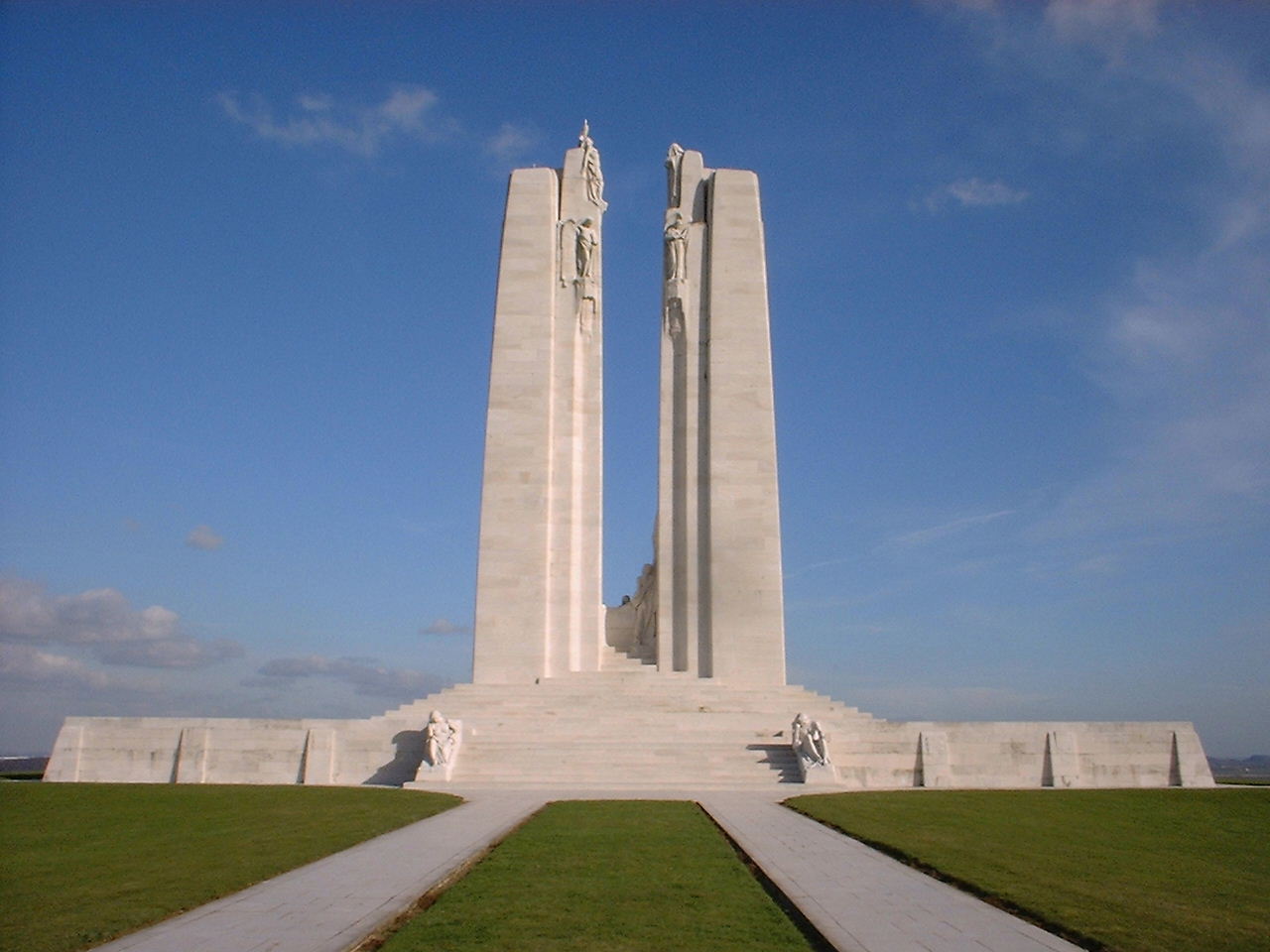
As the path rounded a curve, I had my first glimpse of the Canadian Monument through the few remaining trees.  The monument was exactly that: monumental, made of pale limestone, towering high into the sky, a startlingly white pair of tall, narrow pylons emerged from a sturdy platform base.  The base was half a football field in size. Much like uniform columns, the twin pylons scraped the sky at thirty meters height. Surrounding the monument was a treeless, level, grassy park, groomed by a close cut, without the unusual dips and peaks.

A few low tree limbs brushed me with an embrace before I reached a wide, white stone double walkway. It was perfectly straight, leading directly through the open park to the monument.  A large sign, brown and yellow, at the junction of the paths finally triggered my memory.  Vimy Ridge is a Canadian National park.  My visits to Banff and Algonquin National Parks suddenly came back to me.  How remarkable that here I stood, thousands of kilometers and across the Atlantic ocean from my home country, a guest in a foreign land, yet on Canadian soil.  Another sign explained that the French government had gifted this 250 acre area in perpetuity to Canada out of gratitude following the Great War.

Although the park buildings had not opened, the monument was accessible to pedestrians. A young woman stood sideways to me, alone between the pillars of the still distant platform, wearing a pale dress and bright red sweater, unbuttoned and hugged close with her arms crossed tightly in front.  Her loosely worn hair blew in the breeze.  She turned away from the monument, eyes down, and stepped swiftly on light feet down the steps towards me along the white path.

It was difficult to be indifferent to this place.  More signs, these ones concise and direct: ‘Silence and Respect’, they demanded.  Walking this path towards the monument, I felt a change.  The monument was at the edge of a ridge.  Hanging over the plain of Lens-Douai, a stormy sky was the monument’s dark gray backdrop.  Ahead and far below, where the ridge plummeted into the wild growth, two joggers ran soundlessly in unison on the circular road that bordered the outer limits of the park around the monument.

I looked back to the monument just as the young woman reached me.  Her eyes remained downcast and her quick steps told me she would not stop to speak.  One hand was at her mouth and tears streamed down her cheeks.  In the quiet of this solemn place I heard her sob softly as she passed me by, like a reflection.

The sun shone brightly on the monument from the sky above, despite the stormy sky over the plain, illuminating beautiful, larger-than-life figures carved into the peaks of the pylons.  No one was at the monument now, and it soared over me as I approached.  The base, above the height of my head, had markings that started to materialize.  Thousands of names, some with rank, were inscribed upon the outer walls of the base.

Before climbing the steps to the platform, I slowly surveyed the chiseled names.  Stark and plain, I reached out and touched them.  Cold, smooth.  There was no life in that rock.  It was not the warm pink granite of our great Canadian Shield. My surname was carved close by, several times, along with many other names. So many names.  I did not come to Vimy to seek a lost family member but found myself wondering: were these men distant relatives, unknown to my life because theirs had ended here?

I turned back and climbed the steps to the platform between the towering twin pylons.  Looking high to their peaks, the sun warmed my face and dazzled my eyes as I squeezed them shut.  At that moment, eyes shut, I heard a distinct sound pierce the silence.  High-pitched and faint, the only sound… a living thing… peaceful… a bird.  “And in the sky the larks, still bravely singing, fly…”

With my eyes shut in silence I heard the din.  Guns and artillery exploded, the sounds of carnage and destruction.  Not a blade of grass was visible in my mind.  Not a leaf on a tree or an unbroken trunk, leaning, roots grasping, withstood the desolation.  No white stone platform protected me from the mud, blood and death at my feet.  The sky, thick with smoke and heavy overhead cloud, caused a bone-chilling dampness.  As real as the tears that welled in my eyes, I heard and felt this. Fear and sorrow gripped my soul.

When I opened my eyes again, the grass was groomed and green, the leaves of the trees still fluttered in the breeze, the sun shone down from the sky above, and the joggers ran a second lap round Vimy Ridge.  Time moved on and the park buildings opened.

The balance of the day was spent in a wonderful explore of the history of Vimy Ridge during the Great War.  The Interpretive Centre, loaded with artifacts and displays, tells the story of how Canada came together as a nation.  I was treated like royalty by the two young men working there, dressed in familiar tan shirts and brown pants, Canada’s National Parks uniform.  As I entered I greeted them tentatively, “Bonjour …”

“Canadian! Welcome home,” was the warm response. I had stepped into Canada.

A walking tour of the tunnels and trenches showed the conditions under which our men in arms, branded British but proudly Canadian, so valiantly fought the enemy upon that ridge.  The enormous craters at the Front were formed on the same day that Canadians won the ridge.  Those craters still remain.

In the tunnels, towards the end of the tour, the guide said, “These tour tunnels were widened, ceilings raised and modern lights installed.” He indicated to a dull passageway. “This tunnel, off limits for your safety, is preserved with the low ceilings, narrow walls and dull lighting of 1917.”

As the tour moved on, I hung back, pressing against the barrier to peer down the banned passageway. In the tense, oppressed atmosphere, dozens of men in uniform leaned and sat against the walls, waiting to be called from the tunnel to attack in no man’s land. Some sipped lukewarm tea made with brackish water. Two spoke softly, so as not to be detected by the enemy. Another, his helmet momentarily set aside, squinted in the dimness at a photograph of his sweetheart. I blinked and they were gone.

Back above, at the park cemetery, tears flowed freely again. Row upon row of gravestones marked the last resting place of so many young Canadian men, boys really, who came to France as I came, but never returned to their loved ones and the country they called home.

I walked a last time along the treed path towards the monument, this time understanding each depression in the ground to be the place where an artillery shell had exploded ninety five years ago.  Thousands upon thousands of them. The trees, leaning to me in the wind, are men: the Canadian soldiers with no known graves, their mortal remains in the Canadian soil of France and pulsing through the veins of the trees, rooted firmly, their maple leaves whispering, “…take me home with you.”  The trees number the same as the names on the monument base: 11,285.  Upon my last visit to the monument, I no longer had it to myself but shared it with many pilgrims, come to pay homage. The pristine chiseled rock basked all day in the sun’s rays but remained icy cold. It is a deception, this park.  So much violence and chaos concealed under a lush layer of growth and brilliant white human engineering.

This place had called to me.  Over an ocean and half a continent it had called.  It called and I came. To the craters, the tunnels, the trenches.  To the monument, the signs and the trees.  But most of all, I came to the place where Canadian nationalism found itself through young men, far from home, bound by a commonality only described as being Canadian.  Men who gave their lives so that we may live in peace.  It called and I came, not just to observe, but to find myself also.  Many times in my life I have been deeply moved, but nothing has moved me more deeply than my day at Vimy Ridge. 

Back in Paris, I entered the hotel lobby a bedraggled traveler. The desk clerk greeted me with unlimited energy. Bonsoir, madame. Je suis désolé pour le mauvais temps. Il a plu toute la journée.

While the sun shone on Vimy Ridge, in Paris it had rained all day.


Brenda Ross lives in Brampton but prefers to be sailing in her favourite place, the North Channel of Manitoulin Island. She has been published in the magazine Latitudes and Attitudes and in the newspaper The Muskokan. Brenda is currently working on a novel. “Visiting Vimy” won the 2012 winner of the Muskoka Chautauqua writing contest.


See Brian Henry's schedule here, including writing workshops and creative writing courses in Kingston, Peterborough, Toronto, Mississauga, Brampton, Georgetown, Milton, Oakville, Burlington, St. Catharines, Hamilton, Dundas, Kitchener, Guelph, London, Woodstock, Orangeville, Newmarket, Barrie, Gravenhurst, Sudbury, Muskoka, Peel, Halton, the GTA, Ontario and beyond.

Friday, October 19, 2012

You can now attend the six-week Writing Your Life course on Monday afternoons – starting this Monday – and it's practically free!


“Writing Your Life”
~ A six-week writing adventure ~
Mondays, Oct 22 to Nov 26
12:45 to 2:30 p.m.
Peel Art Gallery, Museum & Archives (PAMA)
9 Wellington St. E. Brampton, Ontario (Map here.)

If you’ve ever considered writing your memoirs, your family history or just getting your thoughts down on paper, this weekly course will get you going. We’ll introduce you to the tricks and conventions of telling true stories and show you how to use the techniques of the novel to recount actual events. 

Weekly writing exercises and friendly feedback from the instructor will help you move forward on this writing adventure. Whether you want to write for your family or for a wider public, don't miss this course.

Fee: $20 (Regularly this course will cost $180, but to celebrate their re-opening, PAMA is offering all their programs for free or almost free.)

To register with a credit card, phone: 905-791-4055
Or, starting September 30, you’ll be able to register with PAMA online here.
In addition, you should download a registration form here and bring it with you on Monday.

See Brian's full schedule here, including writing workshops and creative writing courses in Kingston, Peterborough, Toronto, Mississauga, Brampton, Georgetown, Milton, Oakville, Burlington, St. Catharines, Hamilton, Dundas, Kitchener, Guelph, London, Woodstock, Orangeville, Newmarket, Barrie, Gravenhurst, Sudbury, Muskoka, Peel, Halton, the GTA, Ontario and beyond.


Finalists announced for the Governor General’s Literary Awards


The Governor General’s Literary Awards are the oldest significant literary prizes for published books in Canada. They’ve lost a little of their lustre, as the Giller Prize for fiction is $50,000 as against $25,000 for a GG, but the GG’s are still an extremely prestigious award and also has several other categories besides fiction and gives out awards in all the categories for books published in French, as well.

This year, I’m interested to see that there’s no overlap between the finalists for the Giller and for the GG’s and if you add in the third big award – the Roger’s Writers’ Trust Prize – there’s still only a few books up for more than one of them. I think that's better than last year when many of the same books popped up on two or three of the lists. It looked downright incestuous.

Below are the finalists that Quick Brown Fox readers might be most interested in. If anyone would like to review any of these (or any of the finalists for theWriters' Trust or the Giller prize), I’d be glad to post your review. Email it to me at brianhenry@sympatico.ca – Brian

Fiction
Siege 13 by Tamas Dobozy of Kitchener, Ont. (Also on the short list for the Roger’s Writers’ Trust Fiction Prize; see here.)
Dr. Brinkley's Tower by Robert Hough of Toronto
The Headmaster's Wager by Vincent Lam of Toronto
The Juliet Stories by Carrie Snyder of Waterloo, Ont.)
The Purchase by Linda Spalding of Toronto. (Also on the short list for the Roger’s Writers’ Trust Fiction Prize; see here.)


Nonfiction
A Thousand Farewells: A Reporter's Journey from Refugee Camp to the Arab Spring by Nahlah Ayed of Toronto
The Pursuit of Perfection: A Life of Celia Franca by Carol Bishop-Gwyn of Toronto
Into the Silence: The Great War, Mallory, and the Conquest of Everest by Wade Davis of Vancouver
Leonardo and the Last Supper by Ross King of Woodstock, UK; originally from North Portal, Sask.
What We Talk About When We Talk About War by Noah Richler of Toronto


Children's Literature, Text
Seraphina by Rachel Hartman of Vancouver (Random House)
Under the Moon by Deborah Kerbel of Thornhill, Ont. (Dancing Cat Books)
The Reluctant Journal of Henry K. Larsen by Susin Nielsen of Vancouver (Tundra Books)
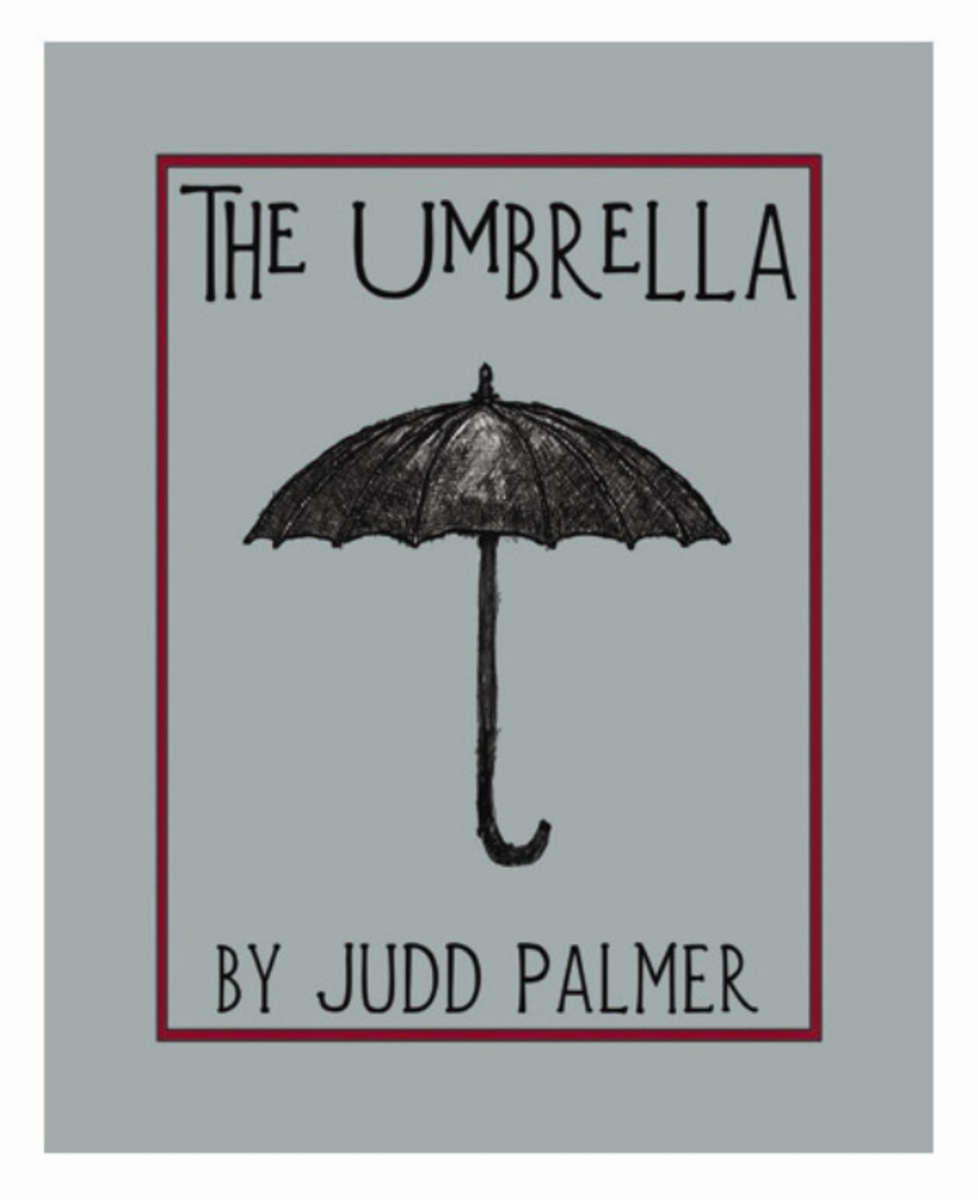
The Umbrella by Judd Palmer of Victoria (Bayeux Arts)
The Grave Robber's Apprentice by Allan Stratton of Toronto (HarperCollinsCanada)

For more information and a full list of the finalists in all categories for the Governor General’s Award, see here.

For the finalists for the Rogers’ Writers’ Trust Fiction Prize see here.

For the finalists for the Scotiabank Giller Prize see here

See my schedule here, including writing workshops and creative writing courses in Kingston, Peterborough, Toronto, Mississauga, Brampton, Georgetown, Milton, Oakville, Burlington, St. Catharines, Hamilton, Dundas, Kitchener, Guelph, London, Woodstock, Orangeville, Newmarket, Barrie, Gravenhurst, Sudbury, Muskoka, Peel, Halton, the GTA, Ontario and beyond.
Thursday, October 18, 2012

The Next Step in Creative Writing course, Thursday evenings, Jan 24 – March 14, in Georgetown

The Georgetown Wordsmiths present...
The Next Step in Creative Writing
8 weeks of creative growth
Thursday evenings, Jan 24 to March 14, 2013
6:45– 8:45 p.m.
St. Alban's Church
537 Main Street, Georgetown, Ontario
(in the village of Glen Williams – Map here.)

This course will challenge you to take a step up in your writing.  The format will be similar to the "Intensive" courses, but with less reading between classes each week, leaving you with more writing time.

Over the eight weeks of classes, you’ll be asked to bring in three pieces of your writing for detailed feedback. All your pieces may be from the same work, such as a novel in progress, or they may be stand alone pieces. You bring whatever you want to work on. 

Besides critiquing pieces, the instructor will give short lectures at the start of class, addressing the needs of the group.
 

In addition to learning how to critique your own work and receiving constructive suggestions about your writing, you’ll discover that the greatest benefits come from seeing how your classmates approach and critique a piece of writing and how they write and re-write. This is a challenging course, but extremely rewarding.
 

Instructor
 
Brian Henry has been a book editor and creative writing teacher for more than 25 years. He teaches at Ryerson University and has led writing workshops everywhere from Boston to Buffalo and from Sarnia to Charlottetown. But his proudest boast is that he's helped many of his students get published.

Fee: $132.74 13% hst = $150.  Payment in advance by mail or e-transfer.
Note: These courses fill up, so enroll early to avoid disappointment.

To reserve a spot now, email: brianhenry@sympatico.ca

See Brian Henry's full schedule here, including writing workshops and creative writing courses in Kingston, Peterborough, Toronto, Mississauga, Brampton, Georgetown, Milton, Oakville, Burlington, St. Catharines, Hamilton, Dundas, Kitchener, Guelph, London, Woodstock, Orangeville, Newmarket, Barrie, Gravenhurst, Sudbury, Muskoka, Peel, Halton, the GTA, Ontario and beyond.

Bayeux Arts seeks authors

The Umbrella by Bayeux Arts editor
Judd Palmer is a finalists for a 2012 Governor
Generals Award for children`s literature
Bayeux Arts Incorporated
119 Stratton Cres SW
Calgary, AB  T3H 1T7
http://www.bayeux.com/

Bayeux Arts is an independent publishing house located in Calgary, Alberta. It produces about eight to ten titles per year. Bayeux is committed to producing books of beauty that build bridges across cultures. As its name was intended to suggest, the artistic nature of its books represents the cornerstone of its publishing program.

"Our list is deliberately eclectic and contains books that other publishers often shy away from publishing. We publish these books because they deserve publication and because they deserve to be read."

Bayeux published fiction and nonfiction for adults, children`s literature, comic books, books focusing on business and entrepreneurship that chart a course for business for a new enlightened planet, and odd little books.

Bayeux Arts is interested in finding new authors. Please send digital preview manuscripts to the appropriate director and clarify if you are sending a simultaneous submission. Graphic Novel Submissions should be sent as links to ftp sites. We will respond to your submission within three months.

Mercedes Bátiz-Benét, Editor, Fiction, Nonfiction & Poetry, Mercedes@bayeux.com 
Judd Palmer, Editor, Children’s Literature, jpalmer@bayeux.com
Biographies here. Full submission guidelines here.

Brian Henry will lead a "Writing for Children and for Young Adults" workshop in Newmarket on September 22 (see here) and in Milton on November 3 (see here). 

See Brian's full schedule here, including writing workshops and creative writing courses in Kingston, Peterborough, Toronto, Mississauga, Brampton, Georgetown, Milton, Oakville, Burlington, St. Catharines, Hamilton, Dundas, Kitchener, Guelph, London, Woodstock, Orangeville, Newmarket, Barrie, Gravenhurst, Sudbury, Muskoka, Peel, Halton, the GTA, Ontario and beyond.

Wednesday, October 17, 2012

Andrew J. Borkowski wins Toronto Book Award for Copernicus Avenue


Congratulations, Andrew! Here’s the story from Mark Medley of the National Post:

Andrew J. Borkowski’s linked collection of short stories, Copernicus Avenue, is the winner of the 2012 Toronto Book Award.

Borkowski’s debut book is set in-and-around the titular avenue, a thinly-veiled homage to Roncesvalles Ave., the west-end Toronto Polish enclave where the author was born and raised.

The other finalists were National Post columnist Dave Bidini for Writing Gordon Lightfoot: The Man, the Music, and the World in 1972; Farzana Doctor for her novel Six Metres of Pavement; Michele Landsberg for her collection of columns Writing the Revolution; and Suzanne Robertson for her poetry collection Paramita, Little Black.

Each of the five finalists receives $1,000, while Borkowski takes home an additional $10,000. (That should buy Andrew a lot of coffees!)

Andrew will be my guest speaker at the Writing with Style workshop Februrary 2 in Brampton. Details here.

See my full schedule here, including writing workshops and creative writing courses in Kingston, Peterborough, Toronto, Mississauga, Brampton, Georgetown, Milton, Oakville, Burlington, St. Catharines, Hamilton, Dundas, Kitchener, Guelph, London, Woodstock, Orangeville, Newmarket, Barrie, Gravenhurst, Sudbury, Muskoka, Peel, Halton, the GTA, Ontario and beyond.

Tuesday, October 16, 2012

Markham Public Library free Short Story Contest – for Adults and Kids


For adults, the library is looking for long short stories, 12,000 – 15,000 words.
Entries must be submitted in an electronic format (preferably in Word)
Email your entry to: lrucchetto@markham.library.on.ca
All submissions must be previously unpublished
All submissions are final; no changes or substitutions permitted
Markham Public Library will not provide editorial comments on the submissions
Deadline: November 12, 2012
Winning stories and some finalists will be published in book form.


One Book, Many Stories Writing Contest for kids, ages 818:
Maximum length: No more than 2000 words, typed.
All stories must be titled either “The Headmaster’s Wager” or “Bloodletting and Miraculous Cures.”

Overall Guidelines:
Have a clear beginning, middle, and end
No handwritten work, please.
Please keep stories appropriate in the scope of language and violence, readers of all ages will be enjoying these stories. One entry per person, please.
Submissions will be accepted in print form at any branch or in electronic form via email to:
kids@markham.library.on.ca
Entries sent in electronic form must be sent as an attachment.
Deadline: Monday, November 12
Kids contest rules here.

See Brian Henry's schedule here, including writing workshops and creative writing courses in Kingston, Peterborough, Toronto, Mississauga, Brampton, Georgetown, Milton, Oakville, Burlington, St. Catharines, Hamilton, Dundas, Kitchener, Guelph, London, Woodstock, Orangeville, Newmarket, Barrie, Gravenhurst, Sudbury, Muskoka, Peel, Halton, the GTA, Ontario and beyond.

Monday, October 15, 2012

Fence Books seeks manuscripts of novels for contest


Fence Books invites entries for a new book contest, the Fence Modern Prose Prize for a book-length work of prose. Prize: $2500 plus publication. Deadline: November 30, 2012

Entries accepted during the month of November only. Entry fee: $28 (includes subscription). Winning manuscript published in Spring 2014. 

Full contest rules and entry information here.

See Brian Henry's schedule here, including writing workshops and creative writing courses in Kingston, Peterborough, Toronto, Mississauga, Brampton, Georgetown, Milton, Oakville, Burlington, St. Catharines, Hamilton, Dundas, Kitchener, Guelph, London, Woodstock, Orangeville, Newmarket, Barrie, Gravenhurst, Sudbury, Muskoka, Peel, Halton, the GTA, Ontario and beyond.