Thursday, December 26, 2019

Short stories, poetry, reviews, and creative nonfiction wanted ~ Themes include the body, illness, health & healing, Christmas, and much more


Note: Don't ever miss a post on Quick Brown Fox.  Fill in the "Follow Brian by Email" box to the right under my bio and get each post delivered to your Inbox. 
Also, you can hang out and chat with Quick Brown Foxes (and vixens) on my Facebook page (here). Just send a friend request to Brian Henry
Finally, if you’re not yet on my newsletter, send me an email, including your locale, to brianhenry@sympatico.ca ~Brian

Bellevue Literary Review is a literary journal that publishes fiction, nonfiction and poetry about the human body, illness, health and healing. This journal is currently seeking submissions for a theme issue on "Reading the Body."
“We are seeking writing that explores various ideas of the body—through metaphor and language (‘heartsick,’ ‘lily-livered’); as first responders (to illness, stress, culture, religion, freedom); and as agents of change. When we change emotionally or spiritually, our bodies alter; when our bodies alter, our attitudes and spirit do too. Our bodies tell us our truths, reveal our truths, and sometimes blindside us with truths we may not have known. They sing an eloquent, often unconscious song.”
Deadline: January 1, 2020.  But after that deadline, the journal will doubtless open up for submissions for its next issue. Guidelines here.
This journal also offers annual literary prizes. Submissions for that will open March 1, 2020. See pieces by previous winners here.

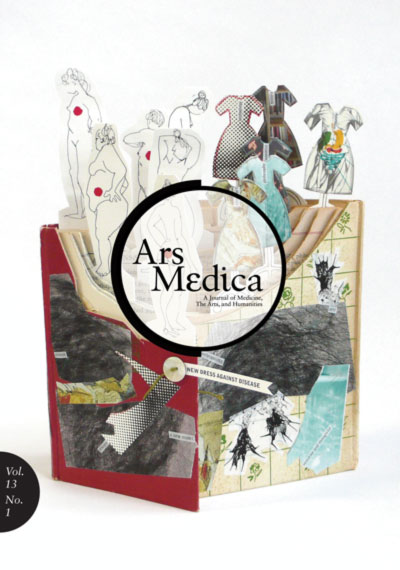
Ars Medica is a literary journal that explores the interface between the arts and healing, and examines what makes medicine an art. Content includes narratives from patients and health care workers, medical history, fiction, creative nonfiction, poetry, and visual art. The journal also include sections on writing by and about children, and writing about international health.
Deadline: Always open for submissions. Guidelines here.

Pixie Forest Publishing is looking for short stories for an upcoming anthology: Phobia! An Anthology of Fear.  Try to think outside the box. Think of phobias that are rare, or write in a genre you don’t think others will.Stories should be between 1,500 and 4,000 words. Pays  $10. 
Deadline: January 15, 2020. Guidelines here.

Chicken Soup for the Soul is looking for true stories on various themes:
Stories about Self-Care and Me Time. Deadline December 31, 2019.
The Magic of Cats. Deadline January 15, 2020.
The Magic of Dogs. Deadline January 15, 2020.
Stories About Christmas. Deadline January 30, 2020.
Be You {Previously this theme was “You Go, Girl!”}. Deadline January 31, 2020.
Listen to Your Dreams. Deadline February 28, 2020.
Pays $200. Guidelines here.

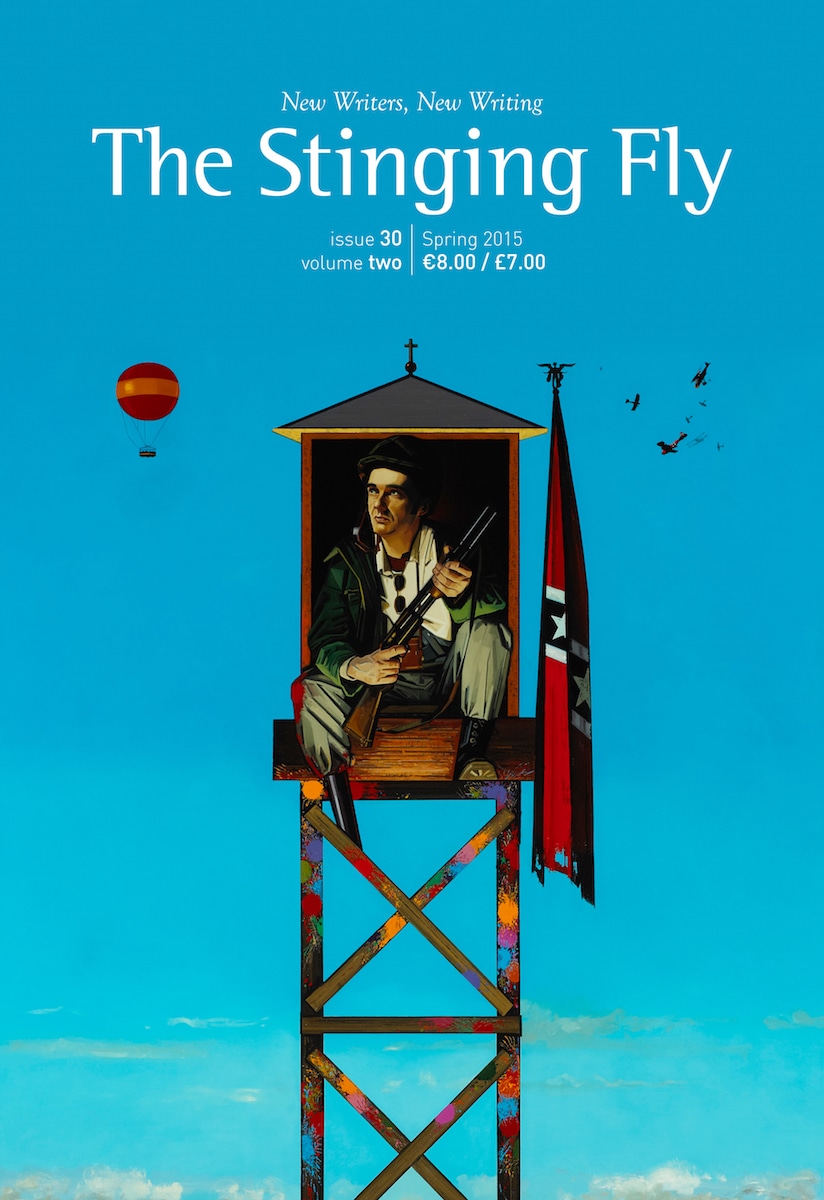
The Stinging Fly magazine was established in 1997 to seek out, publish and promote the very best new Irish and international writing. Seeks fiction and poetry. Pays €25 per magazine page for fiction; €40 for single poem or magazine page; and €200 to a featured poet
Deadline: January 16, 2020. Guidelines here.

Rattle publishes poetry and translations. General submissions are open year-round, always welcomed, and always free. 
Currently Rattle is also seeking Postcard Poems: "The poems may be any style or subject, but must have been written on and be accompanied by a related postcard. Homemade postcards, artists you know, or public domain/Creative Commons licensed art is preferred. Our goal is to support and encourage the act of writing poems on postcards and sharing them in this personal and intimate way." Pays $100. 
Deadline for postcards theme: January 16, 2020. General submissions always open. Guidelines here.

Quick Brown Fox Quick Brown Fox welcomes your short stories, poems, and essays about reading, writing, favourite books, and libraries. Read a few pieces on the blog to get a taste of what other writers have done (see here and scroll down). Quick Brown Fox also welcomes book reviews – or any kind of review of anything, of anywhere or of anybody. If you want to review your favourite coffee shops or libraries, babysitters or lovers (no real names please), go for it. See examples of book reviews here (and scroll down); other reviews here (and scroll down).
Include a short bio at the end of your piece and attach a photo of yourself if you have one that’s okay.

See Brian Henry’s schedule hereincluding writing workshops, weekly writing classes, and weekend retreats in, Bolton, Barrie, Brampton, Burlington, Caledon, Collingwood, Georgetown, Georgina, Guelph, Hamilton, Jackson’s Point, Kingston, Kitchener-Waterloo, London, Midland, Mississauga, Oakville, Ottawa, Peterborough, St. Catharines, Southampton, Sudbury, Toronto, Windsor, Woodstock, Halton, Muskoka, Peel, Simcoe, York Region, the GTA, Ontario and beyond.

Tuesday, December 24, 2019

“My first White Christmas” by Kay Vollett


As a young child in Australia, I impatiently awaited Christmas, counting down the days until my mother took me to the city to visit Santa Claus so I could give him my list of wants, those gifts which I hoped he would bring me on Christmas Day.  Afterwards, we had lunch at Cahills restaurant and my treat was a bowl of vanilla ice cream smothered with their famous caramel sauce. It was then off to see the magnificent Christmas window displays at David Jones department store. 

It never concerned me that it was summer, even though the radio played  North American songs whose words expressed the hope of a white Christmas. I am sure my mother often wished it would snow, as she slaved over a hot stove, keeping up the English tradition to which Australians then adhered of a hot Christmas lunch with all the trimmings, including plum pudding with custard and fruit cake. 

Every year Mother wove a beautiful wreath of eucalyptus leaves from the trees in our backyard, which she tied with a silver ribbon and hung on the front door.  A medium- sized pine tree adorned with home-made decorations took pride of place in the dining room.  I hung a Santa sack on my bedroom door so that the minute I opened my eyes on Christmas day, I could see it bulging with my presents. 

Christmas Eve was open house with friends and neighbours coming and going at various times to share a few drinks. Mother and her best friend, then attended midnight Mass. As Dad was not Catholic, he babysat me. 

On Christmas Day evening, after our big lunch, we joined Aunts, Uncles and cousins at my maternal grandmother’s home for dinner, a giant potluck.  Everyone brought leftovers but instead of being hot, the turkey and ham were served cold with salads and lots of desserts.  

It was a time to relax after the Christmas celebrations, share laughter, love and the joy of one another’s company.

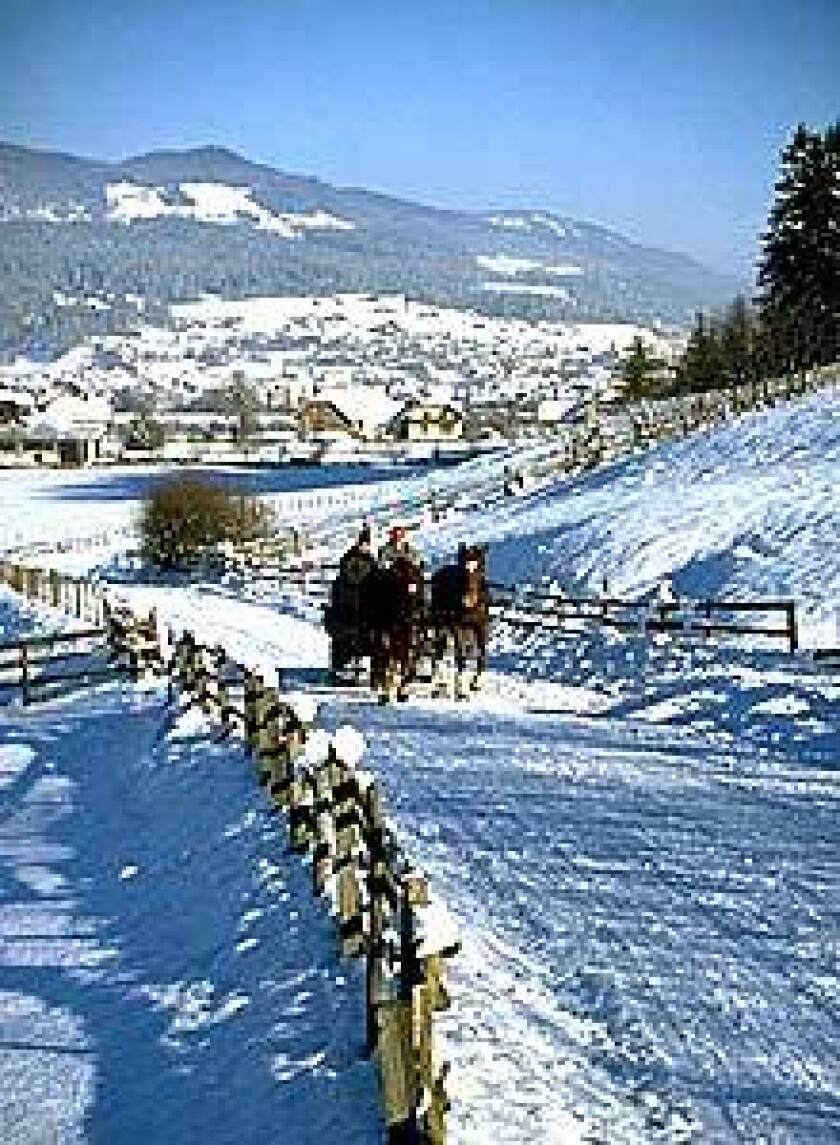
When I travelled overseas in my early 20s, I wanted to experience a European white Christmas so my first December away, I stayed at a ski lodge in a small village in Austria.  I learned that Christmas Eve was the main event and was enthralled to see the local children arrive at the church in the village square on their skis closely followed by the adults and younger children in their sleighs.  I felt I was in a Hallmark movie. The church was intimate and at the end of each pew, adorned with boughs of greenery, there were large metal holders containing a candle which cast a warm glow.

After the service, everyone gathered in the village square, including guests from the lodge, many of whom were from North America, The locals sang their carols with Silent Night bringing tears to my eyes, and we foreigners sang our well loved hymns and songs. It was enchanting and I wrapped myself in the ambience.  So this is a white Christmas, I thought.

I stayed snuggled in bed Christmas Day, missing breakfast.  I couldn’t shake the overwhelming feeling of homesickness.  Hunger finally drove me to the dining room for lunch. I pasted on a smile for the guests who joked I must have been nursing a hangover.

I had sent Christmas cards and presents to my family and promised I would telephone them on my return to London, where I was living at the time.  Family and friends in Australia filled my thoughts.  I saw my mother fanning herself after she opened the door of the oven to check on the turkey in the 90 degree Fahrenheit heat, my sister playing with Cleo, her small daschund pup, and Dad in charge of the well loved Christmas records, Loretta Young’s The Littlest Angel and Bing Crosby’s Small One, listened to without fail every year on Christmas morning.

I couldn’t wait.  I didn’t care how much it cost.  I ran to reception and breathlessly said, “I need to place a call to Australia.”  The clerk looked surprised, but asked for the number and did as I requested.

The operator asked if he would he accept a reverse paid call from Austria.  “What!” he exploded.

She asked again and he accepted in a calmer voice.

“Hello Dad,” I said.  “How are you?  How was Christmas?  

“Do you realize what time it is Kay?” he demanded in a stern voice.

I suddenly realized Australia was ten hours ahead of Austria and it was midnight there. “Sorry Dad, I just wanted to speak with you and Mother.  I miss you terribly.”  My voice was quivering as Mother took the phone. 

“Did you enjoy your first white Christmas, darling?” she said. 

“It was certainly different,” I said, “and charming, with lots of snow, but very cold.  How was yours?”

“Not the same without you, darling.”  I could hear the yearning in her voice.

My sister, who is ten years younger than I, came on the line and excitedly told me that she had received everything she wanted.

After enquiring about extended family and friends, and their summer holiday plans, tearful goodbyes were finally made. I returned to the lounge and found a chair in the corner where I could be alone, savor the voices of my family, and feel warmed by the memories of those past glorious summer Christmases.

Kay Vollett was born in Australia.  She travelled extensively in her early 20’s, including two years living in Europe before moving to Canada, where she worked for a number of years at the Ontario Legislature for various Cabinet Ministers. On returning to Australia with her Canadian husband, she worked for several State and Federal Cabinet Ministers including a former Prime Minister of Australia. She is now retired and resides in Canada again to be near family.

See Brian Henry’s schedule hereincluding writing workshops, weekly writing classes, and weekend retreats in Algonquin Park, Alliston, Bolton, Barrie, Brampton, Burlington, Caledon, Collingwood, Georgetown, Georgina, Guelph, Hamilton, Jackson’s Point, Kitchener-Waterloo, London, Midland, Mississauga, New Tecumseth, Oakville, Ottawa, Peterborough, St. Catharines, Sudbury, Toronto, Windsor, Woodstock, Halton, Muskoka, Peel, Simcoe, York Region, the GTA, Ontario and beyond.

Monday, December 23, 2019

Intensive Creative Writing courses, Jan 15 – March 11 in Burlington and Jan 17 – March 13 in Toronto


Intensive Creative Writing
Offered in two locations:
Wednesday evenings, 6:45 – 9:00 p.m.
January 15 – March 11, 2020
First reading emailed Jan 8
St. Elizabeth's Anglican Church, 5324 Bromley Road Burlington, Ontario (Map here.)
And
Friday mornings, 10:15 – 12:30
January 17 – March 13, 2020
First reading emailed Jan 10
Glenview Church, Bethlehem Room, 1 Glenview Ave,  Toronto, Ontario (Map here.)
Intensive Creative Writing isn't for beginners; it's for people who have been writing for a while or who have done a course or two before and are working on their own projects. Over the nine weeks of classes, you’ll be asked to bring in four pieces of your writing for detailed feedback. All your pieces may be from the same work, such as a novel in progress, or they may be stand alone pieces. You bring whatever you want to work on. 
Besides critiquing pieces, the instructor will give short lectures addressing the needs of the group, and in addition to learning how to critique your own work and receiving constructive suggestions about your writing, you’ll discover that the greatest benefits come from seeing how your classmates approach and critique a piece of writing and how they write and re-write. This is a challenging course, but extremely rewarding.
Instructor Brian Henry has been a book editor and creative writing instructor for more than 25 years. He publishes Quick Brown Fox, Canada's most popular blog for writers, teaches creative writing at Ryerson University and has led workshops everywhere from Boston to Buffalo and from Sarnia to Saint John. But his proudest boast is that he’s has helped many of his students get published. 
Read a review of Brian's various courses and workshops here (and scroll down).

Fee: $184.96 + 13% hst = $209
To reserve your spot, email: brianhenry@sympatico.ca

See Brian’s complete current schedule hereincluding writing workshops, weekly writing classes, and weekend retreats in, Bolton, Barrie, Brampton, Burlington, Caledon, Collingwood, Cambridge, Georgetown, Georgina, Guelph, Hamilton, Jackson’s Point, Kingston, Kitchener-Waterloo, London, Midland, Mississauga, Oakville, Ottawa, Peterborough, St. Catharines, Saint John, NB, Sudbury, Toronto, Windsor, Woodstock, Halton, Muskoka, Peel, Simcoe, York Region, the GTA, Ontario and beyond.

Sunday, December 22, 2019

Happy Hanukkah!


We lit the first candle tonight - seven more to go :-)

Wednesday, December 18, 2019

Persons of Interest: Inspector Masters Investigates by Michael Joll, reviewed by Nancy Kay Clark


MiddleRoad Publishers, 2019. Available through Amazon.ca here.

I’m sucked right into Michael Joll’s new who-done-it short story collection, Persons of Interest, right away and for two reasons.

The first story, “Death by his own Hands” is an fascinating conclusion to another of Joll’s stories, “In Singapore” (found in the short story anthology Our Plan to Save the World) which ended with a break up, the theft of a gun and the possibility that a young aimless piano player would end up being shot. “Death by his own Hands” reveals what really happened. I suspect Joll’s creative muse wouldn’t let him rest until he figured out the fate of that young man, and so Inspector Masters was born.

Masters’ world also drew me in. This collection of connected short stories is set in rough chronological order between 1924 and 1943. The stories follow the cases and career of British middle-class Masters, veteran of the Great War, during his stint as a colonial police officer in Malaya (present day Malaysia and Singapore).

Michael with Our Plan to Save the World
British colonial life in this far-flung backwater of the Empire is laid out before us in all its racial and class divides. It’s very messy — from a boss who insists that only natives (i.e., non-whites) commit crimes to upper class Brits looking down their noses at Masters to feckless young men psychologically scarred from the Great War. And, always, there’s a beautiful — but unattainable — woman who catches Masters’ eye.

This murkiness allows for not-so-clear-cut villains and solutions to crime cases that do not always result in an arrest and conviction, but somehow come to a satisfying conclusion. Masters does not always follow the letter of the law, but his basic decency shines through regardless.

Though I enjoyed these stories, I had two wishes when reading them.

Firstly, I wished that Masters wasn’t so stiff-upper-lip (even when falling in love). Hell, we aren’t even told Masters’ first name — a conceit perhaps borrowed from Colin Dexter’s Inspector Morse series? I don’t know what I’m supposed to get out of such a straightforward mostly non-personal narrator. Even when he’s describing his admiration for a good-looking woman, he’s so matter-of-fact that I was kept at a distance and so I felt I never got to know the man’s inner workings.

Secondly, I thought that some of the cases were too quickly and easily solved.

But these are small wishes for a book that was otherwise a great read.

Nancy Kay Clark is the publisher and editor of ezine CommuterLit.com and is an award-winning writer and editor based in Toronto, Canada. She has worked with both nonfiction (magazine) and fiction writers in a career that spans 20 years.
This review was previously published on CommuterLit here.
For information on submitting to CommuterLit, see here.

See Brian Henry’s schedule hereincluding writing workshops, weekly writing classes, and weekend retreats in, Bolton, Barrie, Brampton, Burlington, Caledon, Collingwood, Cambridge, Georgetown, Georgina, Guelph, Hamilton, Jackson’s Point, Kingston, Kitchener-Waterloo, London, Midland, Mississauga, Oakville, Ottawa, Peterborough, St. Catharines, Saint John, NB, Sudbury, Toronto, Windsor, Woodstock, Halton, Muskoka, Peel, Simcoe, York Region, the GTA, Ontario and beyond.

Monday, December 16, 2019

Reviews of Brian’s How to Write Great Characters workshop


Hi, Brian. 
I just wanted to thank you for the “Writing Great Characters” workshop on Saturday.  I have been stalled in my writing, and I realized at the workshop it was because I didn't have a clear picture of my character's personality and motives.  Your exercises and handouts have inspired me and I'm happy to say I spent the rest of the weekend writing.  Writer's block conquered (for now, ha)!
Looking forward to all the upcoming workshops.
Marina Unger
Stouffville, Ontario

Brian’s workshops always have new information. Even if I take the same one more than once (which I have), I learn and understand things in different ways. For this workshop, in particular, I especially appreciate the way the character development exercises push my creative side. Of course I enjoy the writing exercise, too, and the helpful feedback on our pieces.  
Thanks, Brian!
Angela Michalak
Barrie, Ontario


Brian Henry has been a book editor and creative writing instructor for more than 25 years. He publishes Quick Brown Fox, Canada’s most popular blog for writers, teaches creative writing at Ryerson University and has led workshops everywhere from Boston to Buffalo and from Sarnia to Saint John. But his proudest boast is that he has helped many of his students get their first book published and launch their careers as authors. 

For upcoming Characters workshops, see here {and scroll down}.
See Brian’s complete current schedule hereincluding Saturday writing workshops, weekly writing classes, and weekend retreats in Algonquin Park, Alliston, Bolton, Barrie, Brampton, Burlington, Caledon, Collingwood, Georgetown, Georgina, Guelph, Hamilton, Jackson’s Point, Kitchener-Waterloo, London, Midland, Mississauga, New Tecumseth, Oakville, Ottawa, Peterborough, St. Catharines, Sudbury, Toronto, Windsor, Woodstock, Halton, Muskoka, Peel, Simcoe, York Region, the GTA, Ontario and beyond.


Saturday, December 14, 2019

“Best Laid Plans” by Kay Vollett

The Patris arriving in Australia in 1966

D-Day had arrived. Not that D-Day but the long-awaited date of my departure overseas on a Greek liner, the Patris. It was January 19, 1966.  I was 22.

My best friend Regina and I had survived our pact that we would save for just one year and then set off on a grand adventure, travelling and working our way around the world with no specific return date to hinder our odyssey.  We had decided on just one year in order to stay focused, not allow the opposite sex to get in the way, nor be sidetracked by other temptations.

We announced our intentions to our respective families.  Regina, her brother Wally, and their mother had arrived in Australia in 1947 as refugees from Lithuania after the Second World War.  Mrs. Lipschus was delighted at our plans but my mother did not share her enthusiasm, warning of the dangers that could befall me.  I am sure she sought solace in the thought that our ambitious plan would not come to fruition as I’d never be able to save the money.

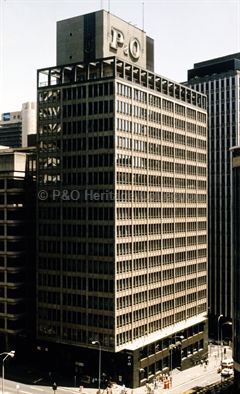
To enable our savings to grow, we needed additional income.  We found evening jobs as cleaners from 5.30 to 9.00 p.m. in the P&O building overlooking Sydney Harbour, which housed the corporate offices of P&O Ocean Lines, as well as other companies, organizations and law firms. 

In addition, a local fruit market offered me a job on Sundays where I often drew the short straw of spending all day sorting and weighing potatoes into 5 and 10 pound bags.  My nails at the end of such a shift were caked with dirt under which I could have grown my own potatoes.  
P&O Building, Sydney, in 1960s

Regina worked on Sundays at a petrol station owned by her uncle.  I also endured eight weeks of waitressing on Saturday nights at a restaurant in one of the rugby football clubs, but was fired after I dropped a tray full of beer over the table I was serving.

I was Personal Assistant to a well known commercial real estate developer, Richard Stanton, where I had been employed since my graduation from college.  It was a hectic office and I rarely had lunch hours in order to arrive on time for my cleaning job.

The landed gentry in Sydney often vehemently objected to one or more of Mr. Stanton’s planned high rise office towers, but he rarely wavered and the young architect he had plucked from obscurity years before went on to become one of the country’s finest.

Mr. Stanton’s other great passion was horse racing.  He owned three champion race horses.  Thoroughbred racing was huge in Australia and attracted all sorts of characters, not all above reproach, especially in the billion dollar gambling industry it spawned.  It seemed that not a week went by without a story in the media about him, cynically referred to as “well known racing identity.”  He was a victim of the “tall poppy syndrome,” rampant in Australia, where the press, eagerly supported by resentful individuals, endeavour to cut down to size some they consider don’t deserve, for whatever reason, the spoils of being at the top.

It was exciting being the centre of attention when reporters swaggered into our office, photographers in tow, seeking to interview him.  I gave my usual response that he was not in, when he was often just six feet away, ensconced in his locked office.  On one occasion the TV cameraman filmed me as I appeared at Reception advising them he was out of town.  This was shown on the nightly TV news with the byline “the elusive Richard Stanton.”

I lapped up the notoriety and Mr. Stanton appreciated my efforts in protecting him from media mogul Rupert Murdoch’s lethal press.  I appreciated the bonus he gave me every Christmas.

Regina worked as a payroll administrator for an Australia-wide construction company.  We met every night at 5.15 p.m. and proceeded to the basement of the P&O building to change into the required blue cleaner’s uniform. We cleaned three floors, two belonging to P&O, one of which was the Accounts Department on the 9th floor and contained wall to wall desks, sometimes still occupied at 7 p.m. by clerks, all male.  


Sydney Harbour 1966, P&O ship Oriana at dock 
The 10th floor, the executive offices of P&O, included a large boardroom with an enormous table and a built-in bar awash with every type of liquor, and a massive fridge stocked with beer, wine and soft drink.  On Friday nights, totally exhausted but strangely exhilarated, Regina and I lay back in the soft leather chairs, stretched our legs on the boardroom table and toasted ourselves with a drink from the bar, while the other two Lebanese cleaners, looked on in horror and were afraid to join in.

One of the organizations on the 11th floor, was the Dairy Farmers’ Corporation of New South Wales.  An elderly gentleman with a large moustache and rimless glasses, was always present.  The plaque on his door, indicated his name was James McDougall, Managing Director.  Unlike the young guns in the Accounts Dept. who averted their eyes when we emptied their wastepaper baskets, he always looked up and said hello.  After a couple of weeks, he asked me why I was working as a cleaner.  I bristled at his question, and brazenly responded, “Why, what’s wrong with being a cleaner.  It’s honest work.”

He apologized and said he didn’t mean any offence, but it was rare to see two young Australian women working at that time of night.

I calmed down and informed him of my travel plans with Regina.  He was generous in his praise of our efforts, saying, “I wish my daughter had your initiative.”  Every night after that he left cartons of chocolate milk and sandwiches for the two of us, as he knew we hadn’t had time to eat before commencing our cleaning chores.

We did our cleaning jobs for six months and then found a position sorting mail five nights a week at the large main post office in downtown Sydney, known as the GPO (General Post Office).  This was 6 p.m. to midnight so much longer hours and a lengthy commute on the train at a late hour, but the much higher remuneration made it worthwhile.
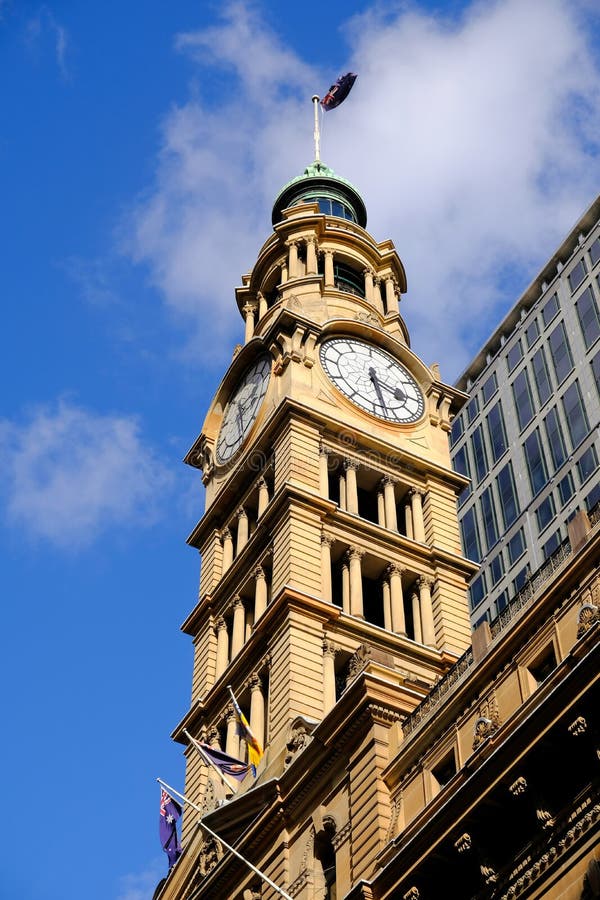
GPO Clock Tower, Sydney 
We gave our notice to the cleaning company and on our last night, Mr. McDougall handed each of us an envelope containing $100, and a note saying, “For when you have run out of money and there is just one more thing you want to see.” 

I hugged him as tears smeared our glasses.  Many years later after I’d returned to Australia, I noticed his obituary in the Sydney Morning Herald.  I never read the obituaries so was sure some divine source had directed me to it.  I went to the funeral and sat at the back of the church, pleased to see the hundreds of people present.  He was a true gentleman.

Our new job at the GPO enabled us to have time to grab a bite to eat before starting our shift.  We became great friends with the Greek owner of the café we attended every night.   He made sure our meal was ready the minute we arrived and served us the best espresso coffee, “to keep you awake,” he chuckled.

Sorting the mail was more fun than work.  We sat on high stools in front of a conveyor belt stretching for approximately 30 feet with workers on each side of it.  The mail in varying shapes and sizes was hauled out of large canvas sacks and thrown on the conveyor belt.  As it dashed towards the cancelling machine, which stamps the envelope with the date and location of the post office, we were supposed to sort it into letters which could be fed through the machine and those that couldn’t. The mail too big to go through the machine was flung into large bins to be stamped by hand.  Because the stools were so high, my shoes usually fell to the floor and on one occasion I saw them hurtling towards me on the conveyor belt, the culprit roaring with laughter.

The nights rushed by in a blur.  We never felt afraid on our journey home as there were quite a few passengers on the train.  My father met us at our station, dropped Regina home and then on entering our house, well after 1.00 a.m., I was greeted by my mother, who had a bath ready for me and woke me each morning with a breakfast tray.  She also ensured the house was kept silent on Saturday mornings to allow me the luxury of sleeping in until lunch time.

Our year of working endlessly finally came to an end.  Christmas arrived and family who had been instructed to only give us money as gifts were extremely generous.  I handed in my notice to Mr. Stanton in November to ensure he had time to hire a replacement.  He was surprised and promised me a big increase if I would stay.  He also suggested I travel for just six months and my job would be waiting for me on my return. I politely declined his generous offer and was shocked when a week before I was due to depart, his driver arrived with a massive gift basket containing champagne and chocolates and a cheque for $1,000.

It was an emotional scene at the wharf on our departure day.  Tearful goodbyes, hugs and kisses and appeals that I write often.  As Regina and I boarded the ship, we stayed at the railing, waving furiously as it pulled away from the wharf, multi-coloured streamers thrown by the passengers fluttering in the wind, until our families were indistinguishable, but already seared into our memory.

We wiped the tears from our eyes and holding one another, shrieked to the seagulls soaring alongside, “We did it!”

Kay Vollet was born in Australia.  She travelled extensively in her early 20’s, including two years living in Europe before moving to Canada, where she worked for a number of years at the Ontario Legislature for various Cabinet Ministers. On returning to Australia with her Canadian husband, she worked for several State and Federal Cabinet Ministers.  She is now retired and lives in Canada again to be near family.

See Brian Henry’s schedule hereincluding writing workshops, weekly writing classes, and weekend retreats in, Bolton, Barrie, Brampton, Burlington, Caledon, Collingwood, Cambridge, Georgetown, Georgina, Guelph, Hamilton, Jackson’s Point, Kingston, Kitchener-Waterloo, London, Midland, Mississauga, Oakville, Ottawa, Peterborough, St. Catharines, Saint John, NB, Sudbury, Toronto, Windsor, Woodstock, Halton, Muskoka, Peel, Simcoe, York Region, the GTA, Ontario and beyond.